Spin Mop vs Flat Mop: Which Should You Stock?
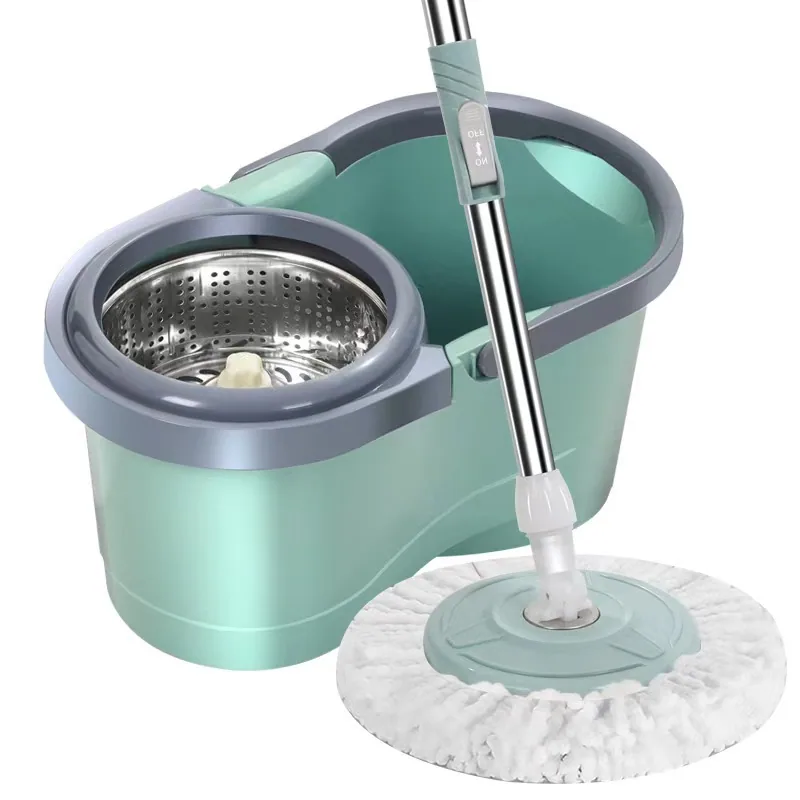
If you are weighing spin mop vs flat mop for your next container, the short answer is that both sell, but they sell to different shoppers. The spin mop set is the big-box volume item: a bucket, a wringer and a rotary head in one carton. The flat mop is the repeat-purchase item: lighter, cheaper to ship per unit, and tied to a refill stream. Read the mechanism, then the buyer, then the price tier. That is the order that keeps a range healthy.
We make both. Our spin mop sets and flat mop systems sit in the same Yiwu catalogue, so this is not a pitch for one side. It is a view from the factory floor on where each one earns shelf space.
How the two mechanisms actually work
A spin mop uses centrifugal force. You drop the head into a basket, then either press a foot pedal or pump the handle, and the basket spins the water out. Water control is granular: three pumps gives a wet mop, eight gives a damp one. Our Spin Mop Bucket washes and spin-dries in the same bucket, so nobody touches dirty water. The Stainless Steel Dual-Drive Spin Mop Bucket uses a pump action on the handle instead of a pedal.
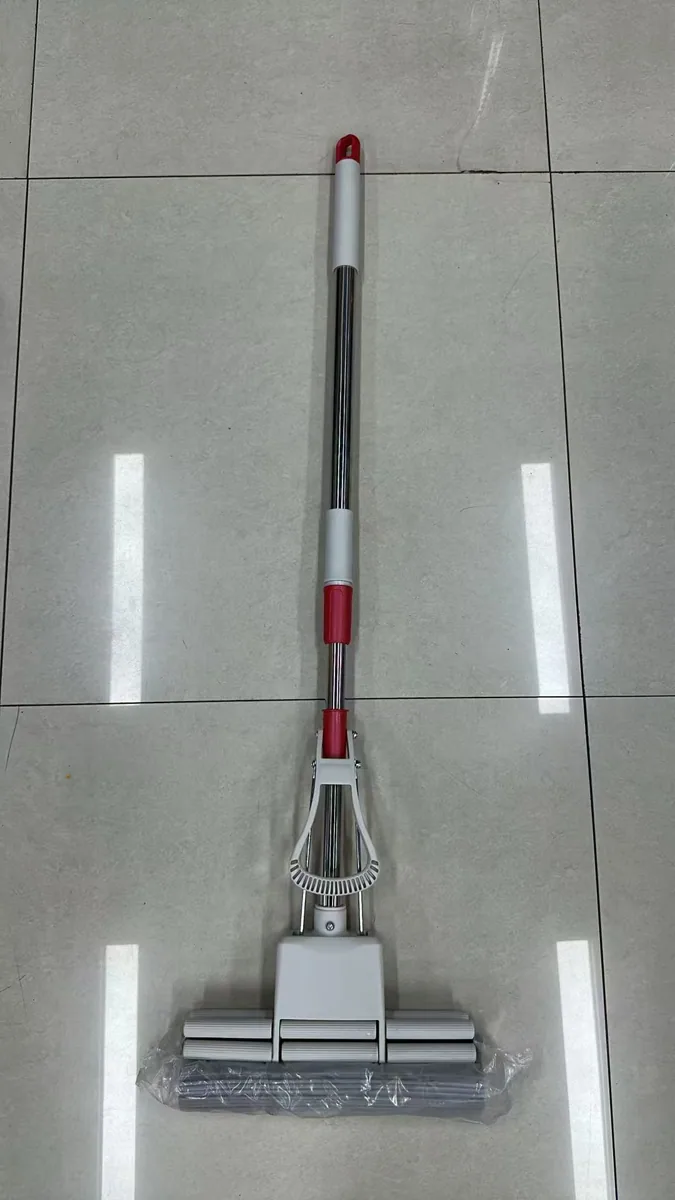
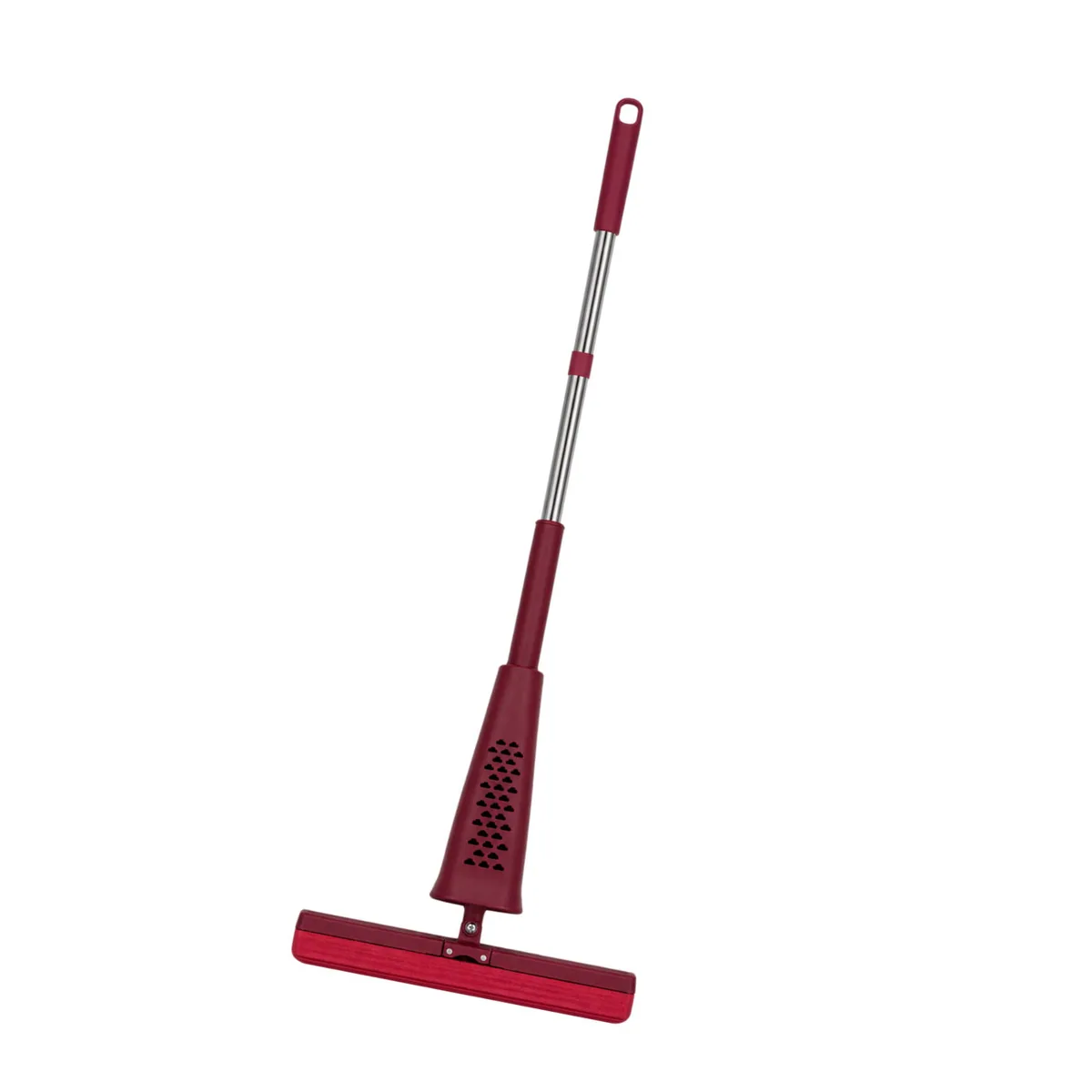
A flat mop wrings by pressure, not rotation. The common designs are a scraper blade you pull the pad through, a dual-chamber bucket that rinses in one side and squeezes in the other, or a sliding sleeve on the handle that pushes a scraper down the pad. Look at the Hands-Free Mop: a sleeve drives a dual-track scraper along the pad and the dirty water runs off the head. No bucket at all. The Scratch-Off Mop Bucket takes the other route, with a wash chamber and a separate scraper chamber so clean and dirty water stay apart.
Here is the blunt part. A spin bucket is a plastic-heavy product with more parts, more packing volume and more that can break in transit. A flat mop is a stick and a pad. That difference drives everything downstream: carton size, freight per unit, returns risk and the price you can put on the shelf.
Water control and floor types
Spin mops win on adjustable moisture. That matters on tile and stone, where you want a wet pass followed by a drier one. It also matters on sealed hard floors where a soaked pad leaves streaks. The trade-off is weight: a full spin bucket is heavy to carry up stairs and awkward in a small bathroom.
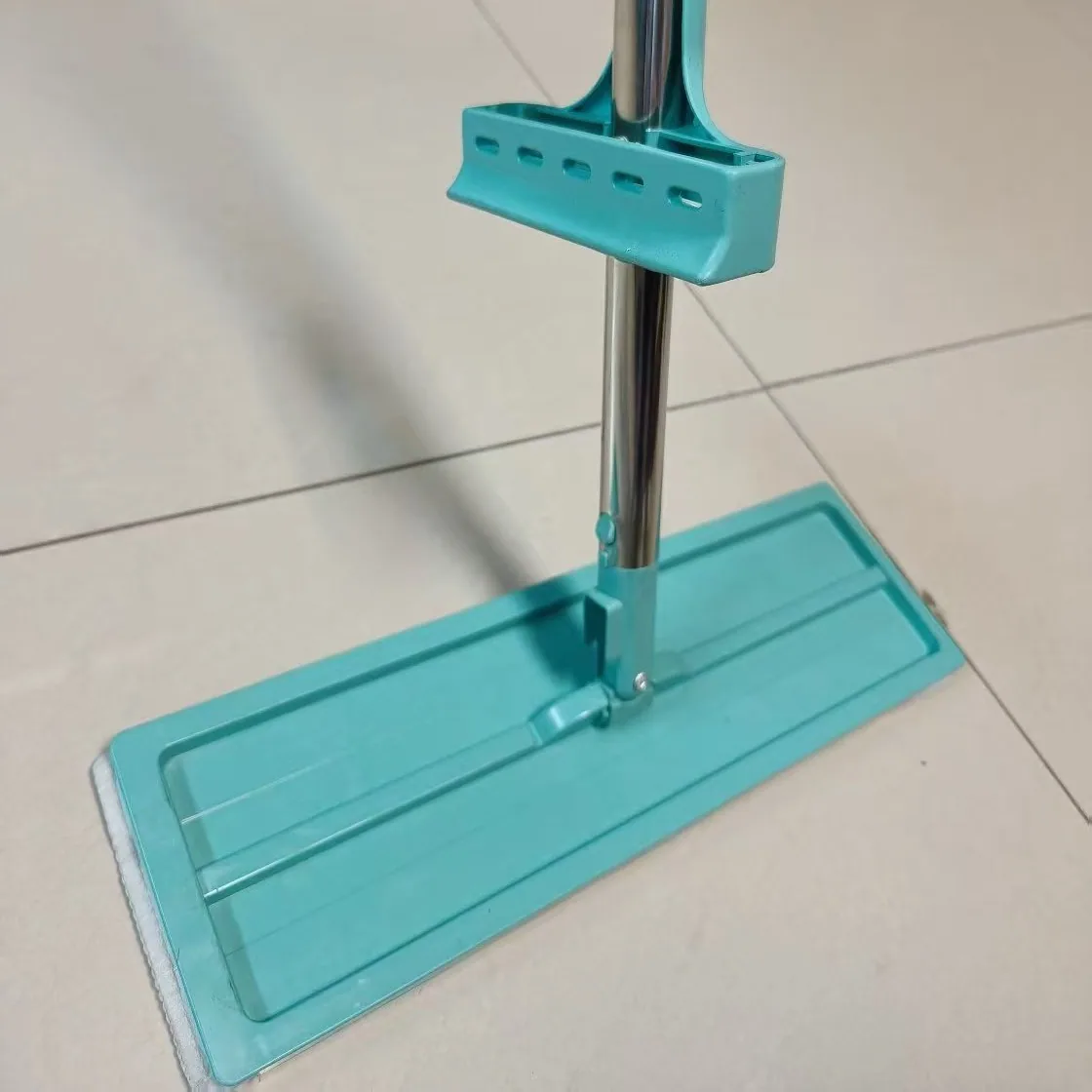
Flat mops win on control at the head. A 35 cm pad on a low-profile tray slides under furniture and along skirting. Our 35cm Hand-Wash-Free Flat Mop is built for wet and dry cleaning of tile, with a superfine fibre pad on a 35 x 12 cm tray. Microfibre itself is the reason flat mops clean so well with so little water: the split fibres trap dust and grease rather than pushing it around, as described in the Wikipedia entry on microfiber.
For dry dusting and pet hair, a chenille flat mop is hard to beat. The Chenille Mop uses a deep open pile that holds hair instead of scattering it. If your market is mostly tile and laminate, flat mops carry more of the range. If it is mixed hard flooring with a lot of wet spills, spin sets hold their ground.
One caution for both: wet mopping is not the same job as dry mopping, and the general guidance on floor cleaning is that unsealed wood and some laminate should not see a soaking wet mop. Sell the dry pad or a barely damp microfibre as the companion item, not as an afterthought. The Wikipedia article on floor cleaning covers the dry versus wet distinction in plain terms.
Side by side: what a buyer needs to compare
| Factor | Spin mop set | Flat mop system |
|---|---|---|
| Wringing mechanism | Centrifugal basket, pedal or handle pump | Scraper blade, dual-chamber bucket or sliding sleeve |
| Water control | Fine, by number of spins | Good, by pressure and pad choice |
| Best floors | Tile, stone, mixed hard floors, wet spills | Tile, laminate, wood (damp), dry dusting, under furniture |
| Storage footprint | Bucket plus pole, bulky | Pole and pad, often hangable or foldable |
| Refill story | Replacement heads and baskets | Pads, often the main repeat purchase |
| Price tier | Higher ticket, gift and first-home appeal | Entry to mid ticket, multipacks work |
| Typical buyer | Families, new movers, big-box shoppers | Apartment dwellers, older shoppers, value buyers |
| Freight per unit | High volume per carton | Low volume, easy to mix |
That table is the whole argument in one screen. The spin set is a considered purchase. The flat mop is a habit purchase, and habits repeat.
Storage, refills and the repeat-purchase maths
Retailers underestimate refills. A mop without a refill line is a one-off sale. With one, it is a small annuity. Spin mops need heads and occasionally baskets. Flat mops need pads, and pads wear out faster because they are thinner and used more often. Our mop heads range covers PVA sponge, chenille microfibre, 4-ply and 8-ply cotton yarn, and 80/20 polyester-polyamide microfibre pads, so a flat mop line can be kept alive with a single refill SKU per head size.
Watch the clip systems. A proprietary pad clip locks the shopper into your refills, which is good for you and annoying for them. A tooth-clip head such as the Multi-Functional Cloth Clip Mop takes ordinary cloths, which lowers the entry price and removes the refill income. Decide which model you want before you brief a supplier. If you want the refill business, specify a pad format and stick to it across the range. Our guide to microfibre mop pads goes deeper on materials.
Storage is a quieter selling point than buyers admit. Small flats and rented apartments have nowhere to park a bucket. A flat mop that hangs on a hook or folds flat has an advantage in urban markets. A spin bucket is a commitment of floor space, and shoppers in compact homes know it.
Price tiers and who buys each
Spin sets sit in the mid to upper part of the mop shelf. They read as a complete solution, which is why they do well as gift items, first-home purchases and promotions. Flat mops sit lower, and that is their strength: you can build a good-better-best ladder with three pads and one handle.
Say you run a hardware chain in a market where tile floors dominate. A spin set as the hero item with a flat mop as the value alternative is a sensible pair. Imagine a supermarket buyer in a city market with lots of apartments: flip it, lead with flat mops and use the spin set as the upgrade. Neither answer is wrong. It depends on floor mix, home size and what your shopper already owns.
For a private-label range, the flat mop is usually the easier first OEM project. Fewer parts, simpler tooling changes, faster colour iteration. The spin set needs more attention to basket tolerance and wringer mechanics, though our mould development and production sit in one company, with 300+ injection moulding machines and annual output over 5 million units.
Ordering considerations before you commit
- Check the minimum order on each listing, not on the category. Stock minimums differ by item and apply to that item only.
- Decide the pad format first. It determines refill SKUs, clip tooling and the shelf story.
- Ask for handle spec in writing. Our reinforced stainless steel or aluminium handles run 0.4 to 0.6 mm wall thickness, and products must pass a drop test before leaving the factory.
- Confirm carton dimensions early. Bucket sets and flat mops have very different freight profiles.
- Choose mop head material by market: PVA sponge for absorbency, chenille for dust and hair, 80/20 microfibre for general wet cleaning.
- Ask about PCR plastic parts and recycled cotton fibre if your buyers ask for eco options.
One more thing worth saying plainly: do not stock a spin mop and a flat mop that fight for the same shopper at the same price. Pick the hero, then position the other as the alternative. The Wikipedia article on mops is a useful reminder of how many mop types exist; a range needs a reason for each one.
How to start an order with us
Zhejiang Chuangjie Commodity Co., Ltd. has been making household cleaning tools in Yiwu since 2006, under the Mopglo product brand. You can order stock items from our range, each with its own minimum on the listing, or go OEM with your colours, logo and packaging. OEM minimums run 2,000 to 8,000 pieces per style per colour, and a pre-production sample is confirmed before mass production.
Send your target market, floor mix and price tier to mopglohome@gmail.com, or use the quote form on our contact page. Our team will come back with suitable items from the product range or an OEM proposal. If you are still mapping the category, the types of mops guide is a good place to start.
FAQ
Which is better for my market, a spin mop or a flat mop?
It depends on floor mix and home size. Tile and stone floors with frequent wet spills suit spin mops. Apartments, laminate and dry dusting suit flat mops. Many buyers stock both and position one as the hero and the other as the alternative.
Do flat mops really need fewer refills than spin mops?
Flat mop pads tend to wear faster because they are thinner and used more often, so the refill stream can be stronger. Either way, a mop line without refills is a one-off sale. We offer PVA sponge, chenille microfibre, cotton yarn and 80/20 microfibre pads.
Can I order both types under one private label?
Yes. OEM orders run 2,000 to 8,000 pieces per style per colour, with Pantone colour matching, logo by embroidery, silk print or heat print, and custom retail packaging. A pre-production sample is confirmed before mass production.
What is the minimum order for stock items?
Each stock item has its own minimum shown on its product listing, and that figure applies to that item only. Email mopglohome@gmail.com with the items you are considering and we will confirm current minimums.